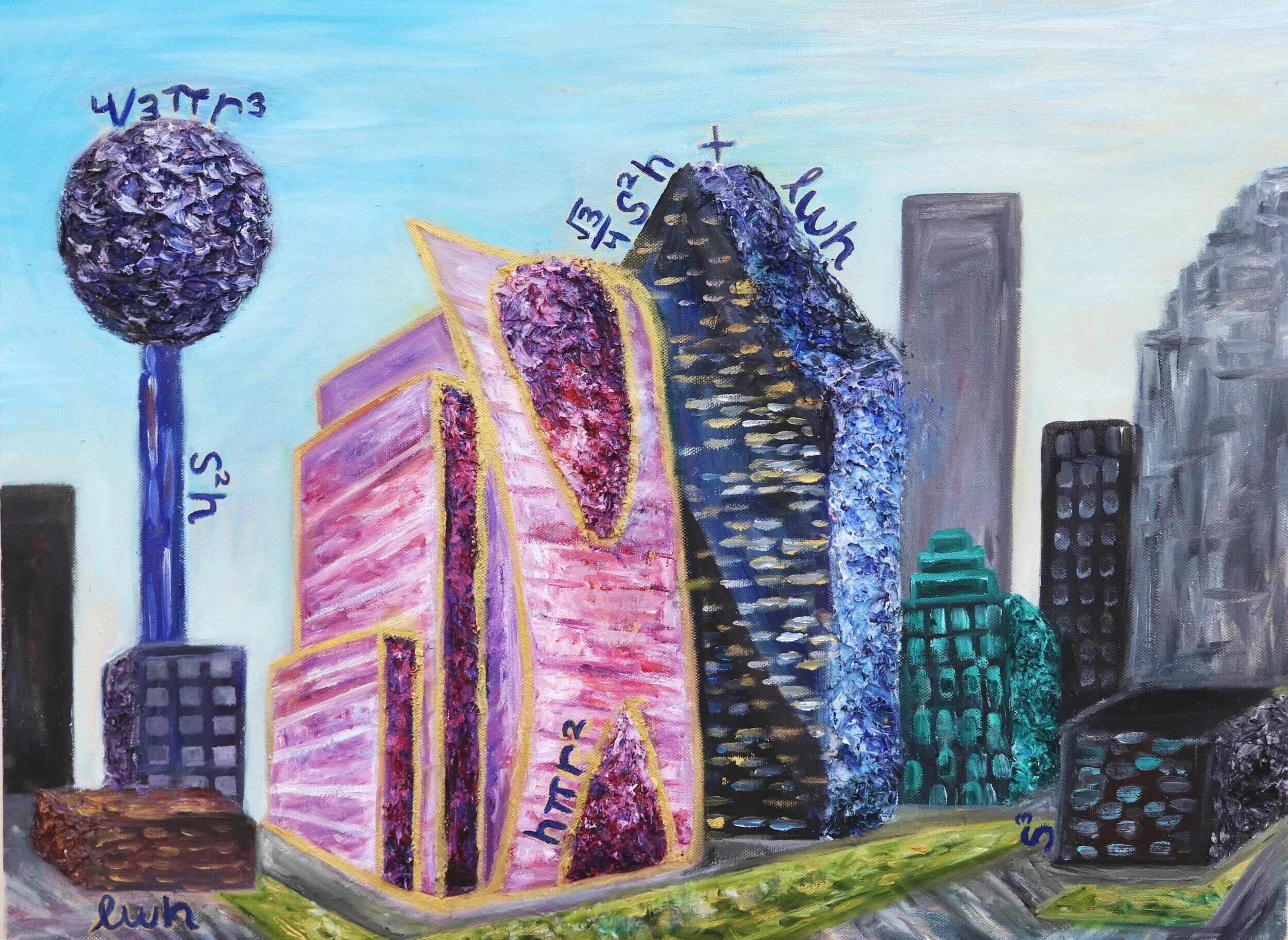
Mathematical Connections.
As part of my AP Studio Art portfolio during my senior year of high school, I began a new series focused on the intersection of math and art.
Alongside art, math has always been one of my favorite subjects—even as a senior struggling my way through multivariable calculus. Whenever I learned a new theorem, equation, or formula, I found myself wondering where it showed up in the world around me. Often, the answer was surprisingly visual. As I started exploring those connections, I realized that numbers, despite all their complexity, can also be really beautiful. My concentration became a way to explore that intersection between math, art, and the everyday world.
Taking inspiration from da Vinci's polyhedron drawings and Brunelleschi's experiment of linear perspective, I aimed to reveal the hidden beauty of numbers through this body of work. I took the theoretical, abstract elements of mathematics and transformed them into concrete representations of line and color. From rose curves to the golden ratio, math illustrates the infinite potential of art, and I strive to share this idea with others.
”Painting is a science and all sciences are based on mathematics.”
-Leonardo daVinci
Research
Before beginning my concentration, I first conduced preliminary research of artists in history with mathematical inspiration and implications in their artwork.
One of the most well known artists is Leonardo daVinci, who was not only an artist but also a scientist and a mathematician. Among his most famous drawings is the Vitruvian Man, where he illustrated human proportions and anatomy by using mathematics to describe the perfect physical features of a man. He also illustrated a book called Divine Proportion which included drawings of over 60 geometric shapes. Other notable artists are Alberti and Brunelleschi, who together developed the fundamentals of linear perspective and the vanishing point. These concepts are very relevant to architectural drawing, both within buildings and on streets. Lastly, even Pablo Picasso’s cubist work has some relation to mathematics due to its use of geometric shapes.

The Golden Ratio
The golden ratio is very closely related to something called the Fibonacci Sequence, which is the series of numbers 0, 1, 1, 2, 3, 5, 8, 13, 21, 34,..., where the next number is found by adding up the two numbers before it.
When we take any two successive Fibonacci Numbers, their ratio is very close to the Golden Ratio, which is approximately 1.618034. In fact, the bigger the pair of Fibonacci Numbers, the closer the approximation.
In geometry, the Golden Ratio can be used to create a spiral known as the golden spiral, a logarithmic spiral whose growth factor is the golden ratio. In other words, the golden spiral gets wider by a factor of 1.618034… for every quarter turn it makes.
Some artists and architects believe the Golden Ratio makes the most pleasing and beautiful shape. In fact, the golden ratio can be found in nature all around us: in plants, flowers, and even in skeletons. Some studies have even shown that the most attractive and visually pleasing faces follow the golden ratio. For example, many scholars believed that daVinci used the golden ratio when painting one of his most famous works, the Mona Lisa.
In this drawing, I showed how the golden ratio is even apparent in one of the most basic body parts: the ear.
Quadric Surfaces
Mathematically, quadric surfaces are the graphs of any equation that can be put into the general form:
Ax^2+By^2+Cz^2+Dxy+Exz+Fyz+Gx+Hy+Iz+J=0
Each of these equations corresponds to a different 3D structure.
There are countless quadric surfaces, but some of the most common depict shapes very similar to everyday objects, a few of which I explored to the left.

The Pringle
(Hyperbolic Paraboloid)
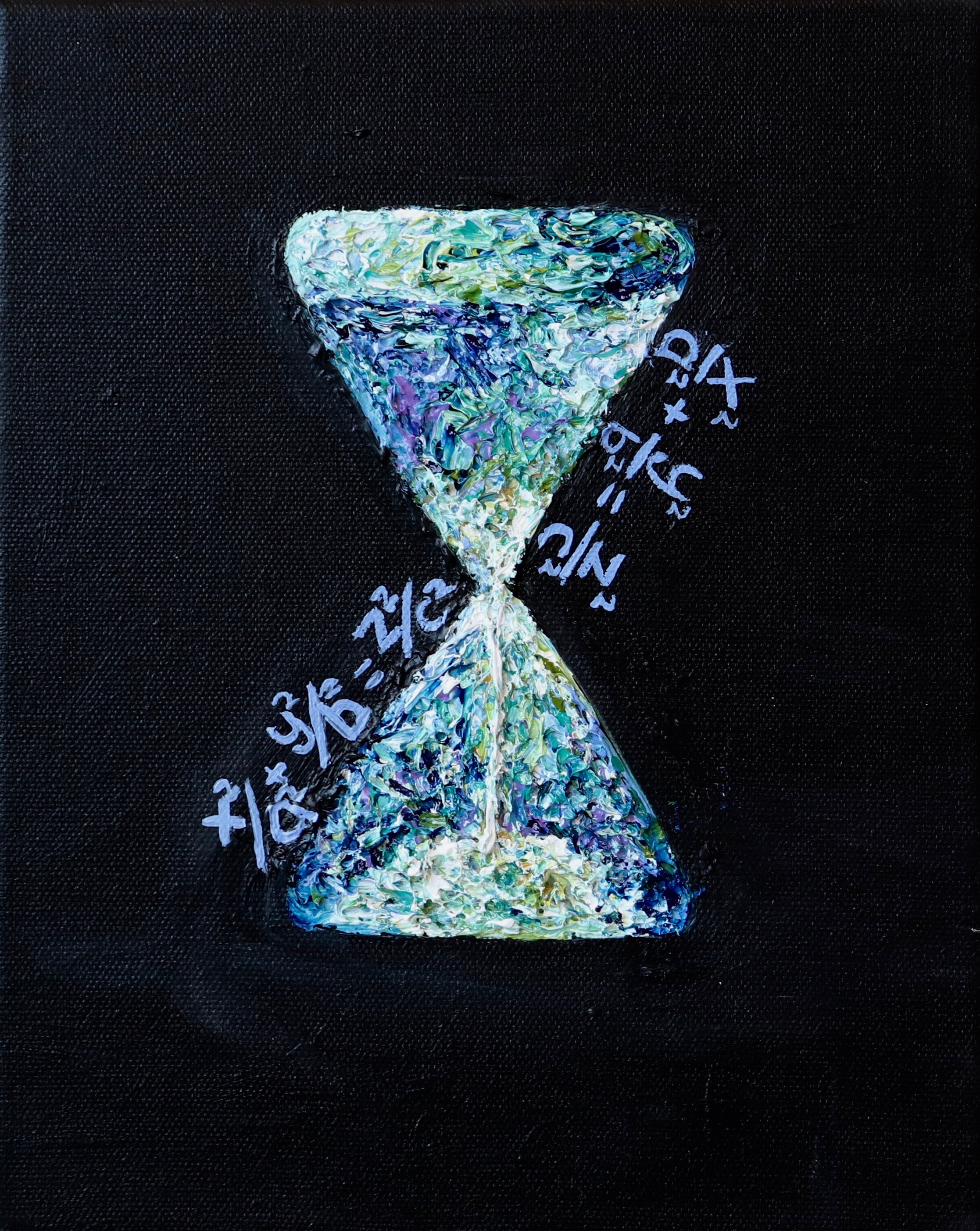
Hour Glass
(Elliptic Cone)

Fractals.
As my concentration evolved, my work became increasingly abstract. I found myself drawn to the intricate patterns hidden within mathematics, especially fractals, complex forms created by repeating a simple process again and again. A fractal is a curve or geometric figure, each part of which has the same statistical character as the whole. I was fascinated by how something governed by mathematical rules could produce shapes that felt so organic, unpredictable, and beautiful.
Through this piece, I depict the aesthetically pleasing, infinite patterns fractals can create. I aimed to create a fractal both within each canvas as well as through the shape of the canvases themselves.
Contour Maps
Contour maps begin with three-dimensional mathematical functions, z = f(x, y). By taking slices of these functions at different heights, we create level curves—paths along which the value of z remains constant. Imagine walking around a hill without ever stepping uphill or downhill: the path you trace would be one of its level curves.
When these curves are projected onto a flat plane, they become contours. Layering contours from different heights creates a contour map, translating a three-dimensional surface into a collection of two-dimensional lines.
I was drawn to the unexpected beauty of these maps. Depending on the function, simple equations can unfold into intricate, organic patterns—turning something mathematical into something that feels almost like a work of art.
To the right, I painted one example of a contour map. My goal was to create an abstract piece of art that could easily fit in someone’s home or office but simultaneously contained a hidden mathematical construction.

Other Works.
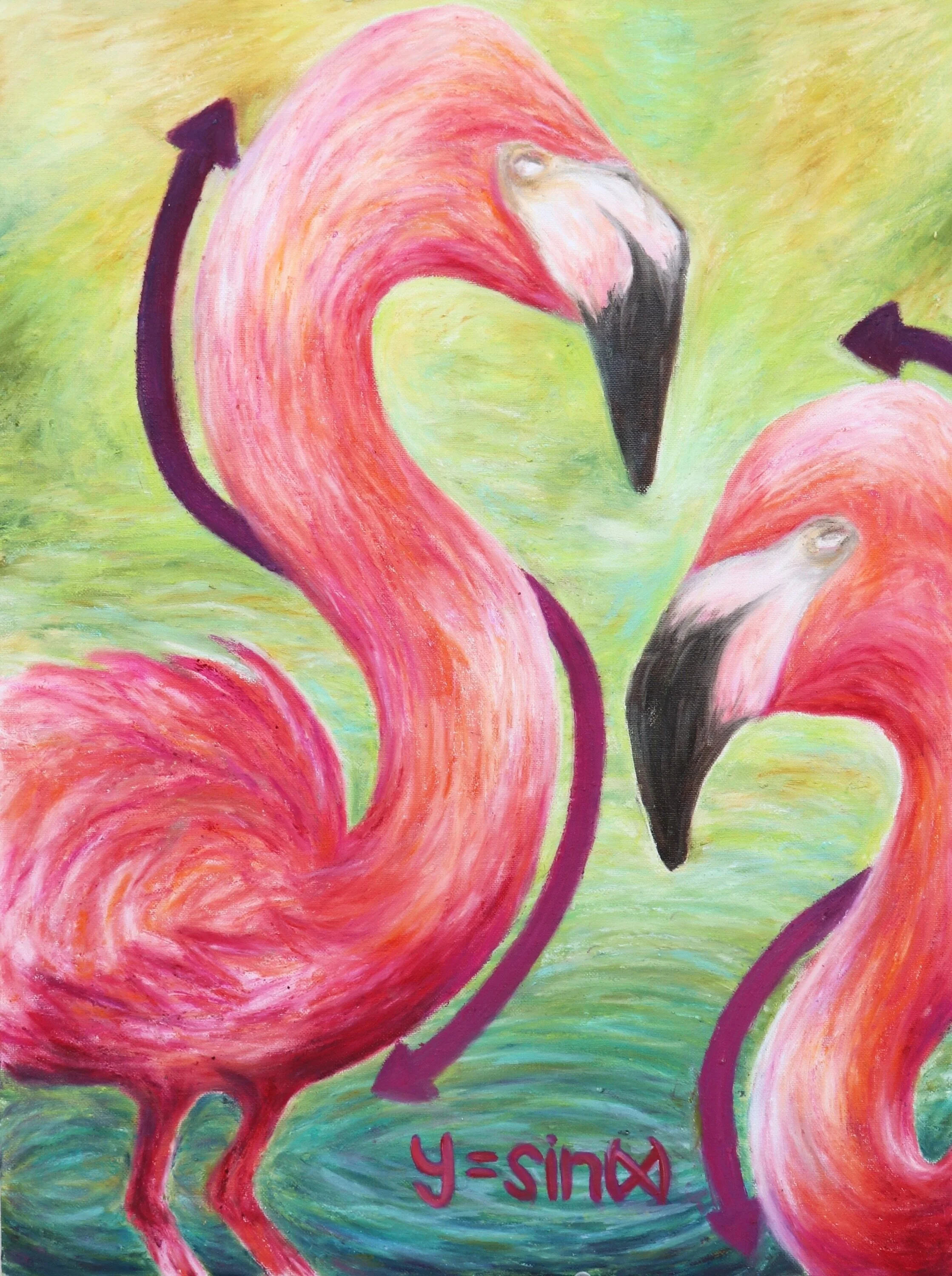
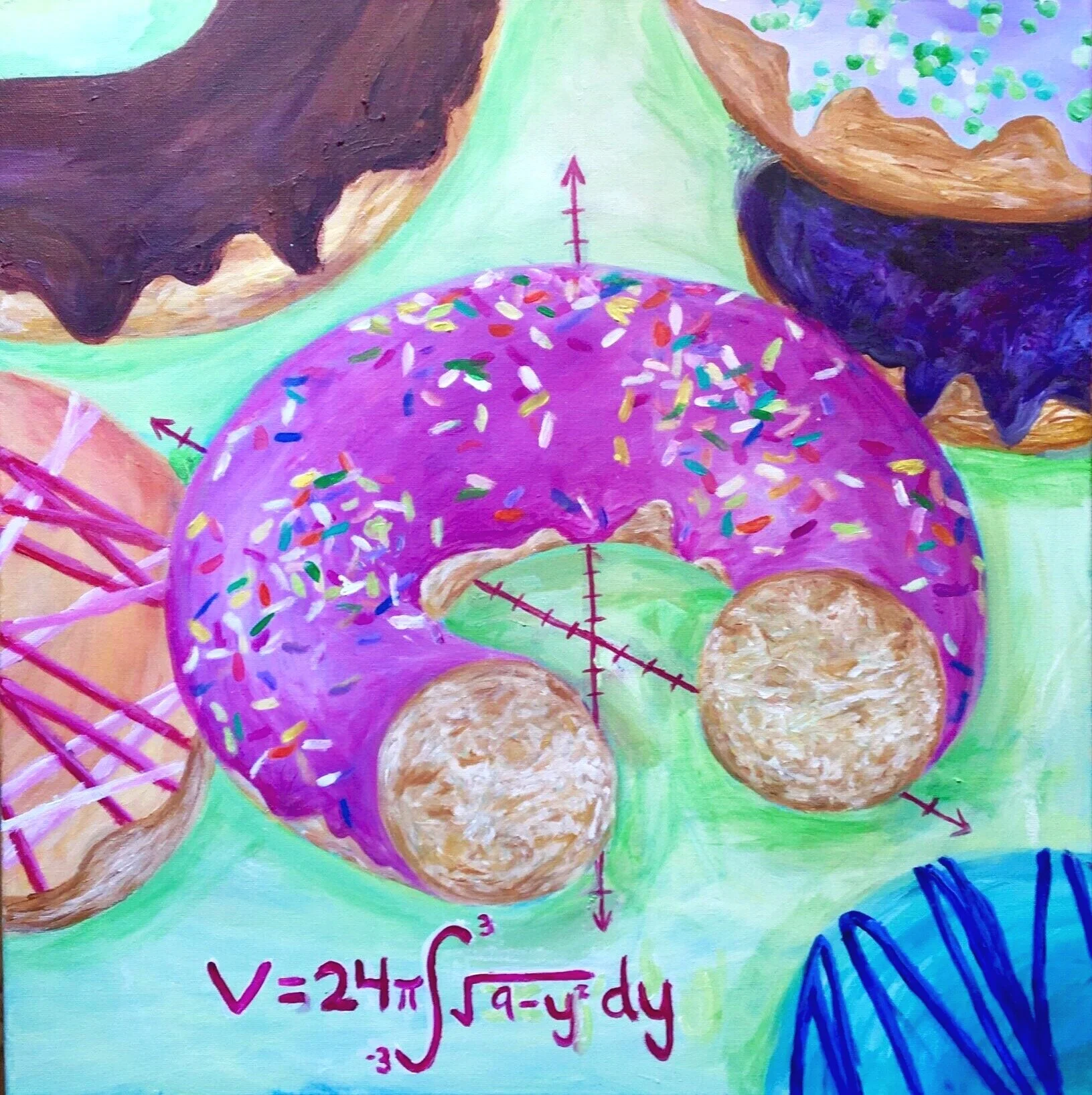
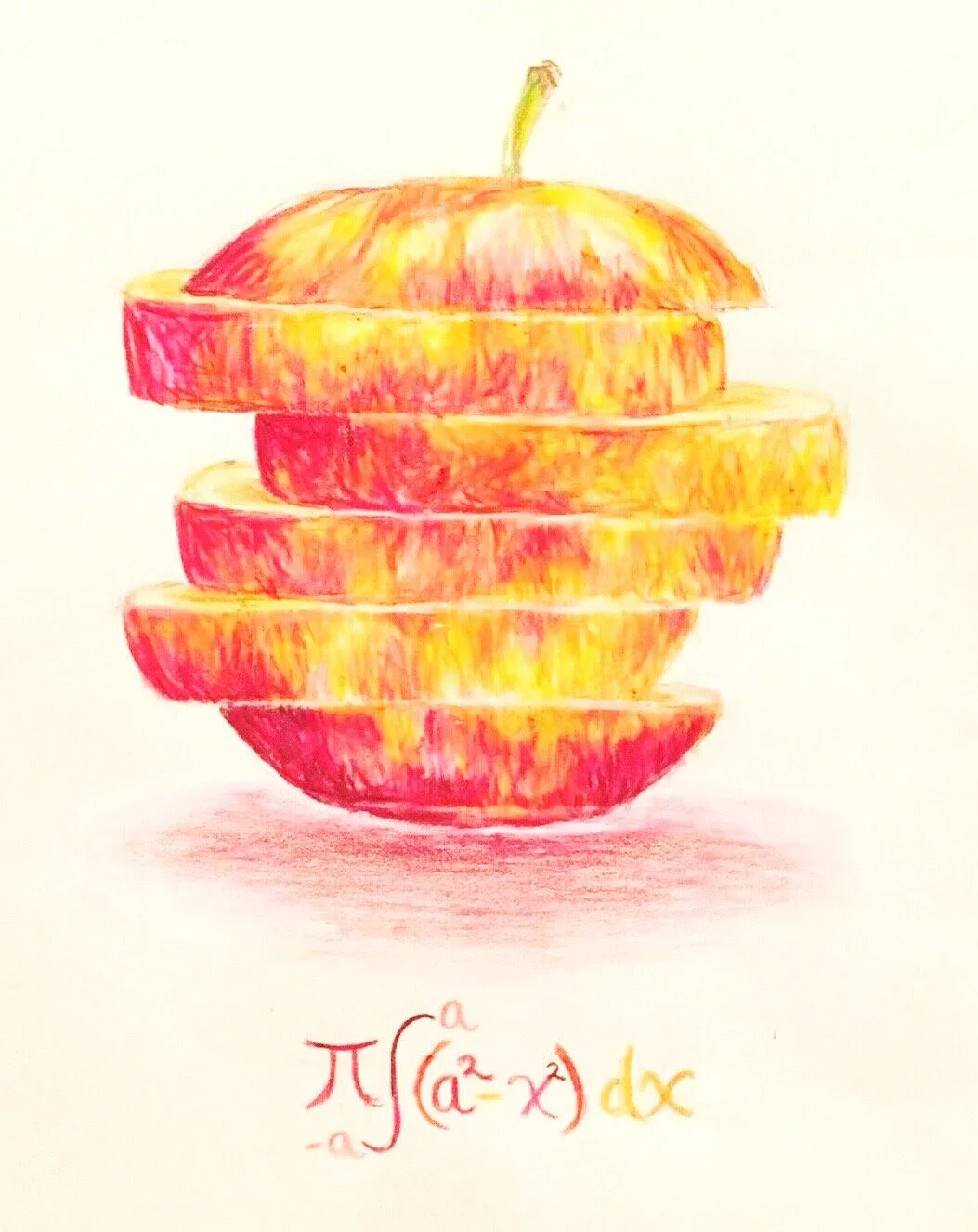
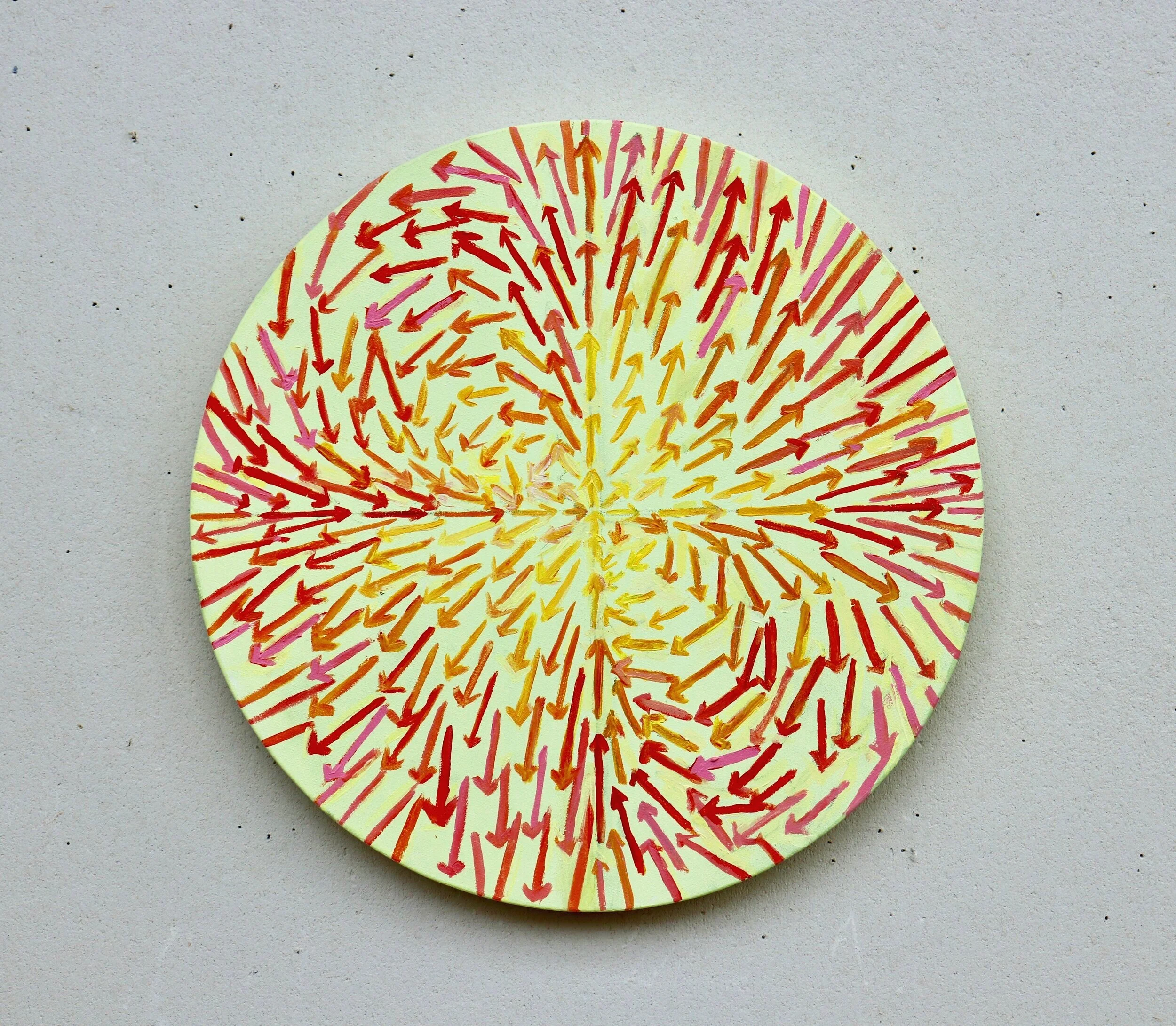
These pieces explore mathematical concepts including trigonometric curves, integration techniques used to find volume, polar curves (rose curves), vector valued functions, and 3-D objects.